History, criminology and sociology of caporalato in Italy
Caporalato in Italy is not a recent emergency but a historical, structural phenomenon: its origins, criminological evolution and the sociology of labour exploitation.
The recent news stories about labour exploitation linked to caporalato (illegal gangmastering of labour) — the case of the Chinese workers in Prato, the murder of the labourers locked in a minivan and burned alive in the Cosenza area, to name only the latest known episodes — lead us almost inevitably to define this phenomenon as something contemporary and tied exclusively to today’s migration. That is a mistake of perspective.
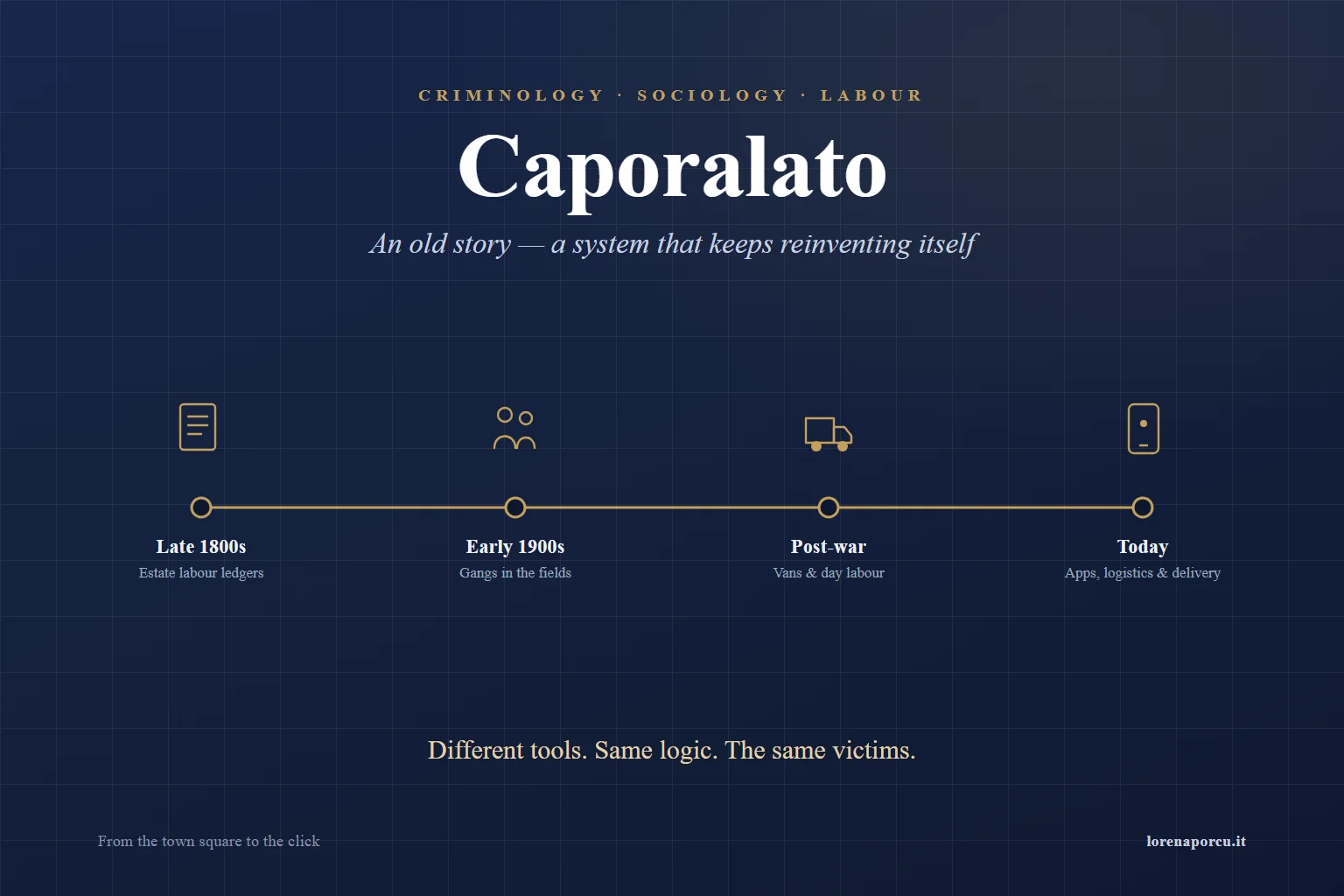
To understand caporalato fully we must strip away the idea that it is a recent emergency or an exclusive by-product of the modern waves of migration. Sociologically, caporalato is an endemic, structural and historical phenomenon of the Italian economy — and not only the Italian one. We can trace its origins at least to the nineteenth century, though it is far older still: it runs through the transformations of the twentieth century only to regenerate again in the twenty-first. Caporalato too, like any system, adapts to the times and to the market.
A historical phenomenon, not a recent emergency
The historical stages in the evolution of caporalato are amply supported by historiographical and economic sources and by the sociology of labour. In recent history we see it clearly in the countryside of the second half of the nineteenth century, before and after Italian unification. The caporali (gangmasters) ran genuine networks of exploitation and social control over agricultural workers, in a context of transition from feudalism to agrarian “proto-capitalism”.
With the birth of the national market and the development of large landed estates — the latifondo (large estate) in the South, the great rice and cereal farms of the Po Valley in the North — the owners (“masters”) found themselves having to recruit enormous masses of labourers, often for short periods, in step with the harvest, the grape-picking or the weeding of the rice fields. The landowner did not deal directly with the recruitment of the peasant masses: he delegated it to a local intermediary, the caporale.
The term, borrowed from military jargon to denote the person in charge of a squad, identified a strong man, often a trusted former peasant, who gathered the labourers in the village squares at dawn: he decided who worked and who did not, set the pay and kept a share of it for himself.
Already by the late nineteenth century the problem of exploitation was evident and significant, yet commonly accepted. The Jacini parliamentary inquiry (1877–1884) highlighted how Italian labourers were wholly subject to unscrupulous intermediaries, owing to widespread unemployment and illiteracy. The Faina inquiry (1906–1911), commissioned to examine the conditions of peasants in Sicily and the South, documented the power of the caporali and their entrenchment. Even then, these inquiries described in detail conditions of semi-slavery and the absolute power of these intermediaries, from the fields of the South to those of the Po Valley.
The twentieth century: trade unions, Fascism and the post-war years
Over the course of the twentieth century, caporalato became the main battleground between the newly formed trade unions and the landowners. In the North, the struggles of the mondine (the women who weeded the rice fields) and the first strikes by farm labourers, led by the “Red Leagues” (of socialist inspiration) and the “White Leagues” (of Catholic inspiration), arose precisely to break the monopoly over job placement held by the caporali, demanding a public and transparent system.
It is no coincidence that the twentieth century saw many Italians emigrate: the documents of the period attest that the oppressive system of intermediation was one of the triggers of the great transoceanic wave of migration between the late nineteenth and early twentieth centuries.
The two decades of Fascism brought a firm suppression of trade-union demands: the regime effectively declared every form of strike illegal and introduced the Corporations. The only recognised trade union became the one controlled by the National Fascist Party, which institutionalised the control of rural labour in an economy subordinated to the interest of the State. Not even in this context did caporalato disappear: rather, it fell into line with the needs of the great landowners who supported the regime, which stifled every form of protest at birth, including that of the peasants.
In the second post-war period, in the republican Italy of 1949, Law No. 264 was passed (known as the Fanfani Law), establishing the principle that the intermediation of labour is an exclusive monopoly of the State. From that moment, finding work through a private party — the caporale — officially became illegal.
The law, however, ran up against a serious structural failure: the public employment offices proved rigid, bureaucratic and unable to respond at the speed required by agriculture, where labour is needed immediately and the harvest risks rotting. The caporale thus continued to operate in the shadows, filling the void left by the State’s inefficiency.
With Law No. 1369 of 1960 the ban on interposition in the supply of labour — the so-called “contracting-out of mere labour” — was reaffirmed, striking at the caporale’s practice of hiring out labourers to companies. The law was then formally repealed in 2003 by Legislative Decree 276, the so-called Biagi Reform, and subsequent amendments. Its principles, however, have not disappeared: they have been reworked and developed within modern legislation. Today the supply of labour is regulated and legalised, but contracting-out must be transparent: if it amounts to the mere provision of labour, the contract has no reason to exist and the workers can request to be hired directly by the company they work for, exactly as the old law provided.
From the 1970s to today: the migratory turn
It was between the 1970s and the 1980s that the phenomenon took on its modern features, tying itself for the first time to migratory flows and turning into an even more violent instrument of oppression. Until the 1980s the victims of caporalato were almost exclusively Italian citizens: men and women from the South, or seasonal labourers who moved between regions.
The watershed date is 24 August 1989: at Villa Literno (Caserta), Jerry Essan Masslo, a South African refugee who picked tomatoes under caporalato, was murdered. His death shook the national conscience and revealed to the country that caporalato had found a new, immense mass of people to exploit: non-EU migrants.
Recent developments (2000–2026)
Over the last twenty years the evolution of the phenomenon has accelerated dramatically, following the lines of economic globalisation and digitalisation.
- The 2000s — the industrialisation of exploitation. Caporalato became firmly welded to the mafia organisations. The concept of agromafie (agri-mafias) emerged (coined by the Eurispes-Coldiretti Observatory): the clans control the entire supply chain, from recruitment in the ghettos (Foggia, Rosarno) to transport, through to sale in large-scale retail.
- 2016 — the criminal-law response. After the tragic deaths of labourers cut down by exhaustion under the sun (such as Paola Clemente in 2015), the State responded with Law 199/2016, the so-called anti-caporalato law, which radically amended Article 603-bis of the Criminal Code. Before this provision, the law punished almost exclusively the caporale (the intermediary), often leaving employers unpunished, shielded by the fact that they had not directly used violence or threats. The law broke this alibi, introducing joint criminal liability and acting on both fronts, with direct criminal liability for employers as well and the confiscation of assets.
- The present day (2020–2026) — the technological leap. Caporalato has left the fields and worked its way into the gig economy, into the logistics of the large multinationals, into food delivery, construction and textiles. The caporali no longer use only vans, but subcontracting algorithms, encrypted chats, apps and social media to manage the shifts of invisible workers, both Italian and foreign.
By way of counter-measure, Decree-Law No. 62 of 30 April 2026 (known as the “Labour Decree” or “May Day Decree”), converted with amendments into Law No. 112 of 25 June 2026, introduced so-called algorithmic transparency: it imposes obligations of transparency and traceability towards workers, who have the right to understand the assessments and decisions made by automated systems. Problem solved? Unfortunately not.
Who the caporali are today
Drawing the profile of the caporale means watching the literary stereotype of the overseer with the whip evolve. Today we can define him as a manager of the hidden economy, a deviant cultural mediator, a “logistical facilitator”. Some of his prerogatives, however, remain the same.
- Age and sex. The average age is generally between 35 and 55. The role requires a wide network of relations with the local business fabric and a deep knowledge of migratory routes, of the ghettos and of the bureaucratic mechanisms of exploitation. The caporale is overwhelmingly male.
- Nationality. Two broad profiles coexist: the native caporale (Italian), often a former labourer or small entrepreneur who holds a monopoly over relations with local companies and runs the vans; and the ethnic caporale (foreign), a rapidly rising figure who shares the victims’ nationality, speaks their language, knows their cultural codes and often the same initial migratory journey.
- The mechanism of control (the promoted-overseer syndrome). The foreign caporale is often a former victim who, in order to escape exploitation, accepted a pact with the criminal system and climbed its hierarchy. He exploits a perverse line of proximity — common origin, the shared traumas of the journey — to present himself as a “benefactor” or an “older brother” offering protection, housing and work. This closeness then turns into a weapon of asymmetrical and ferocious subjugation: the caporale knows the victim’s weak points and uses them. The result is threats against the person and their family back home, the social shame of migratory failure, the confiscation of documents, and the impossibility of obtaining help because of irregular status, illiteracy and the language barrier.
“Come to Italy, there is work in an onion factory, 9 euros an hour, 1,200 euros a month, rent at 100 euros.” So they had promised a group of Bulgarian women. On arrival in Calabria, however, reality proved a nightmare: there was no factory, no hourly wage, no decent accommodation. They slept in an abandoned tourist facility, without electricity, amid dirty floors and threadbare blankets. Each day they were loaded onto vans and taken to the fields. In two months of gruelling work they had received barely 90 euros.
— Avvenire, by Antonio Maria Mira
The victims
The pool of exploited people — estimated at between 180,000 and 230,000 in Italy, with figures that are close but not identical depending on the database — is heavily segmented along the chain of the criminal organisations. The Ministry of Labour and Social Policies (MLPS) has estimated 160,000 workers in conditions of vulnerability; the Placido Rizzotto Observatory puts at 180,000 the workers at risk of exploitation. Applying to these estimates the approximate share of female labour in agriculture (32%), one arrives at a tentative estimate of the female component subject to exploitation of between 51,000 and 57,000.
- Age. The central and most productive band prevails (20–45), needed to withstand shifts well beyond the legal 8 hours — figures of 10, 12, even 16 hours are reported. There is no shortage of minors (14–17), often unaccompanied foreigners illegally placed in agri-food harvesting or construction, and the “prematurely old” (over 50), wholly dependent on the caporale for bare subsistence.
- Sex. The phenomenon is male-dominated (70–75%) in the sectors of heavy harvesting, logistics and construction. Notable, however, is the presence of women — according to ActionAid, between 51,000 and 57,000 undeclared foreign labourers — concentrated in grape-thinning, in textiles (sweatshops) and in domestic work, exposed to a double vulnerability that includes sexual blackmail and threats to their children (structural gender-based violence).
- Nationality. The Sikh (Indian) community is predominant in the greenhouses of the Agro Pontino (Lazio); Chinese and Pakistani citizens in the textile districts and in the logistics of the Centre-North; citizens of sub-Saharan Africa (Nigeria, the Gambia, Senegal, Mali, Côte d’Ivoire) in the large informal settlements of the South — the ghettos of Foggia, Rosarno, Castel Volturno — for the seasonal harvests; Eastern Europeans (Romanians, Bulgarians, Albanians, Ukrainians) steadily employed in harvesting and logistics across the peninsula. Italians account for roughly 15–20% of the victims, predominantly women in the South and men in construction or transport subcontracting in the North.
How recruitment happens
Recruitment shows how the criminal networks have developed differentiated techniques that exploit the vulnerable channels of migration. Studies by the Placido Rizzotto Observatory (FLAI-CGIL), the Ministry of Labour and the Giacomo Brodolini Foundation identify four main channels.
- The transnational channel (smuggling-to-trafficking). In the countries of origin (for example the Indian Punjab, the rural areas of Romania or Morocco) sub-agents operate who are tied to the caporali present in Italy. Migrants are promised a “travel + visa + secure work” package in exchange for exorbitant sums, up to 15,000 euros. To pay, families go into debt with the very same intermediaries. Once in Italy, the visas prove false or linked to phantom companies: the migrant finds themselves irregular and saddled with an enormous debt, and the caporale presents himself as the only means to work at once and repay the creditors. Smuggling thus turns into trafficking.
- The national reception channel (infiltration of the CAS). The caporali — often called trait d’union — frequent the areas around the Extraordinary Reception Centres (CAS) or the informal settlements. Exploiting the extremely long bureaucratic timescales for the issuing of documents or for the examination of asylum applications, they offer applicants immediate undeclared work. For those without swift legal alternatives, accepting becomes the only way to send money home.
- The traditional channel — “ethnic word of mouth”. Many labourers find work through informal networks of fellow nationals. At production peaks the companies ask their “long-standing” employees to form teams of workers: the more senior worker effectively turns into a caporale. In the large cities, recruitment for construction or logistics still takes place at specific exchange nodes — outlying railway stations, motorway junctions, forecourts where the vans load the workers at dawn to distribute them among the sites.
- The algorithmic channel — “digital caporalato”. This is the form most highlighted by recent dossiers and, in theory, the one most targeted by the 2026 decrees. Contact is made through Telegram or WhatsApp groups and legitimate apps run under pseudonyms. In food delivery or portering, the more structured caporali create legitimate profiles on the platforms using front-men and “rent out” the account to irregular migrants or asylum seekers who could not register legally. The caporale collects the official payment from the app and passes on to the actual worker a minimal piece-rate share — often less than 3 euros per delivery — keeping the rest, imposing financial penalties or blocking the profile via chat in the event of protests.
The Italian case: undeclared work and clandestine work
Within Italian labour sociology it is necessary to map the stratification of irregularity precisely. Not all undeclared work is linked to clandestine status, but all clandestine status is structurally pushed towards irregularity.
- Undeclared work (“off-the-books” or “grey”). It involves both Italian citizens and regular foreigners. It is a legitimate work activity that is not declared to the tax and social-security authorities, responding to a corporate logic of cost compression.
- Clandestine work proper. This is the work performed by foreign citizens without a valid residence permit. In Italy the phenomenon is amplified by regulatory short-circuits: by tying the residence permit to holding an employment contract that pre-dates entry, a structural factory of irregularity is effectively created. The migrant who loses their job becomes clandestine because the bureaucracy does not allow them to regularise their status in time to find another, ending up trapped in the loop of undeclared work or in illegality.
The worst-affected sectors
- Agriculture and harvesting. Tomatoes in the Foggia area, sugar beet in the Po Valley, the grape harvest in the Piedmontese Langhe, the greenhouses of the Agro Pontino.
- Logistics and portering. Large goods-sorting hubs, with rogue contracts, unpaid compulsory overtime and digital caporalato via shift-scheduling apps.
- Construction. Labour recruited for private building sites and major public works, contractually under-classified and in a total absence of safety regulations.
- Accommodation and catering. Waiters and dishwashers — often young people or asylum seekers — who sign part-time contracts for a few hours against actual shifts of 12–14 hours a day.
- Textiles and manufacturing. Subcontractors’ workshops (sweatshops) concentrated in specific districts of the North and Centre, with round-the-clock shifts and the logistical isolation of the victims.
Where the system takes hold
Caporalato does not take hold in a vacuum: it fills the cracks of a stagnant economic system. It grows at rates close to zero, shows weak productivity and an objective demographic decline, and grafts itself onto complex administrative procedures, slow authorisations, a cumbersome regulatory system and a tax burden that is at times unsustainable for businesses and citizens.
- Large-scale retail (GDO). The downward pressure on prices — often through the mechanism of double-reverse auctions — forces producers to compress the only flexible cost: labour.
- The absence of public services. The lack of efficient public transport in rural areas and the absence of a transparent, fast public placement service leave the caporale with a monopoly over logistical services and over matching supply and demand. The success of caporalato lies precisely in its capacity to offer a substitute but perverse welfare — transport, housing, micro-credit, a route to work — where the State fails to guarantee flexibility and immediacy.
- Intersecting needs. On the victim’s side: the biological need for subsistence and the requirement to send remittances to families back home. On the company’s side: the need for extreme and cheap flexibility in order to survive on razor-thin profit margins.
The consequences for the individual and for society
- For the individual. Alienation, dehumanisation, illnesses of premature physical wear, post-traumatic stress syndromes and, in the most tragic cases, death. Consider Satnam Singh (2023), a thirty-one-year-old Indian agricultural worker who died in hospital after a two-day agony: he had been seriously injured while working in the fields at Cisterna di Latina and was not given prompt assistance.
- For society. Distortion of the free market — honest companies suffer the unfair competition of those who enslave — social-security evasion in the billions and the infiltration of the agri-mafias into the legal economic fabric.
If historically caporalato conjures images of the South, contemporary sociological evidence shows that the phenomenon is structural throughout Italy, in forms that are even more sophisticated and “entrepreneurial” in the North. If in the South a traditional, violent and visible form of caporalato prevails — tied to the rural ghettos — in the North the phenomenon has become institutionalised and “laundered” through so-called grey entrepreneurship and shell companies.
The modern caporale operates through sham cooperatives, fictitious service agencies with registered offices abroad, or cascading subcontracting agreements. The client company formally outsources the service to these companies in order to clean up its own accounts — evading VAT and social-security contributions — while applying conditions of exploitation to the workers. Cross-referencing the data from ISTAT, the Ministry of Labour and the Ministry of the Interior certifies a two-sided national phenomenon: in the South (Calabria, Campania, Sicily) there is a higher percentage density of irregularity, but in the North (Lombardy, Veneto, Piedmont, Emilia-Romagna) are concentrated the absolute volumes of irregular workers and the most significant capital.
Given the enormity and complexity of the phenomenon, the law now provides that companies involved in caporalato — so as not to damage workers and the local economy further through closures and seizures — may be subjected to sanctions and to a special administration (commissariamento): the company continues to operate, but with the obligation to regularise all contracts immediately and to clear itself of criminal infiltration. From a sociological and legal standpoint, this mechanism shows that the State does not wish to destroy the enterprise, but to root out the business model based on social dumping, demonstrating that producing within the law is possible.
Why victims do not report
The question “Why don’t they report it, if they live in conditions of slavery?” ignores the complex web of psychological, legal and economic coercion in which the victim is trapped. The Department for Equal Opportunities highlights four main blocking factors.
- The blackmail of the residence permit — the legal trap. Reporting means risking forced return to one’s own country, experienced as the total failure of the migratory project.
- The travel debt. The victim knows that, if they stop working or report the situation, the criminal network with which they contracted the debt would take it out with violence on them or on their family left back home.
- Logistical and cultural isolation — the ghetto. The workers often live in abandoned farmhouses or remote shanty towns, without their own means of transport. Illiteracy or a lack of knowledge of Italian eliminates any capacity to communicate with the outside world.
- Psychological dependence. What is effectively established is an “economic Stockholm syndrome”, in which the exploitation is progressively normalised by the victim as the only price they can pay to survive and send small remittances home.
To break down this wall, Italian legislation provides, through Articles 18 and 22 of the Consolidated Immigration Act, for the issuing of a residence permit for social protection or for serious labour exploitation in favour of those who cooperate with the judiciary. It is managed through the One-Stop Immigration Desk at the Prefectures, but bureaucratic slowness in relocation still limits its effectiveness.
Sociological theories compared
The sociology of labour and of deviance explains the entrenchment and persistence of caporalato through two main interpretive keys, mirroring two opposing political and economic paradigms.
The Marxist, conflict and post-colonial framework
Inspired by the theories of social dumping and dependency, it interprets caporalato as an intrinsic product of global neoliberal capitalism. Its underlying thesis: caporalato is not an isolated criminal pathology or a cultural backwardness, but the necessary side-effect of the pressures of large-scale retail. The commercial giants impose purchase prices so throttled on producers that the latter, in order to survive on the razor-thin margins of globalisation, are driven to compress the only flexible cost factor: labour. The caporale is the functional instrument that allows the extraction of surplus value from a mass of workers stripped of rights and rendered structurally precarious or irregular by the State’s own migration policies.
The individualist and efficiency paradigm
Sociologists of a liberal, rational-choice and Law and Economics bent interpret the phenomenon as a market distortion caused by state inefficiency and uncontrolled immigration. Their underlying thesis: caporalato proliferates where the State fails to guarantee the certainty of punishment and the bureaucratic flexibility needed for the rapid matching of labour supply and demand, owing to the chronic inefficiency of public employment agencies. Massive irregular migratory flows would create an excess supply of labour with no alternatives, which fuels the hidden economy. The solution would lie not in adding bureaucratic constraints to the market, but in rigorously blocking irregularity at the borders, deregulating and simplifying seasonal work — making regular hiring worthwhile — and penalising breaches of competition rules even more severely.
Two opposing readings which, however, converge on one point: caporalato is neither a relic of the past nor a marginal anomaly, but a system that regenerates itself by adapting to every phase of the economy. Recognising its structural nature — historical even before it is migratory — is the necessary condition for countering it without reducing it to a mere news item.