The Universe 25 Prophecy: Behavioural Collapse and Why It Concerns Us
John Calhoun's Universe 25 experiment and the behavioural collapse of its mice, read through the lens of environmental criminology and contemporary sociology.
John Bumpass Calhoun (JBC) was an American ethologist (1917-1995) known for his studies on population density and its effects on behaviour. He carried out numerous experiments, but one in particular is worth remembering: Universe 25, known in the scientific literature as “Death Squared: The Explosive Growth and Demise of a Mouse Population”, published in the Proceedings of the Royal Society of Medicine (Vol. 66, January 1973). The study was conducted in the laboratories of the NIMH (National Institute of Mental Health) in Poolesville, Maryland.
What happened
The scientist built an “ideal” environment for mice, the so-called “mouse paradise”, with the aim of studying the social behaviour of animal populations under conditions of overpopulation and abundant resources. The results were so extreme that they led many — Calhoun himself first among them — to regard the experiment as a possible metaphor for the fate of humanity.
The number 25 indicates that this particular enclosure was the 25th artificial ecosystem built by Calhoun from 1947 onwards. For twenty-five years the author repeated and refined the study, altering the environmental variables, the size of the enclosures and the species used. In his earliest attempts (1947-1962) Calhoun began by enclosing a group of Norway rats in a barn in Rockville. In 1962 he published in Scientific American the results of his first crowded rat experiments, coining the term Behavioral Sink (behavioural collapse).
What made Universe 25 unique
Although the biological principles had already been tested and confirmed in the 24 previous variants (on both rats and mice), experiment number 25 was unique, definitive and never replicated identically, owing to its complexity and structural costs. It was designed as the “perfect and definitive” environment — a cube roughly 2.7 metres on each side, free of predators, kept at a constant temperature of 20 °C, with virtually unlimited food and water and systematic cleaning every 4-8 weeks — in order to isolate a single variable: physical space.
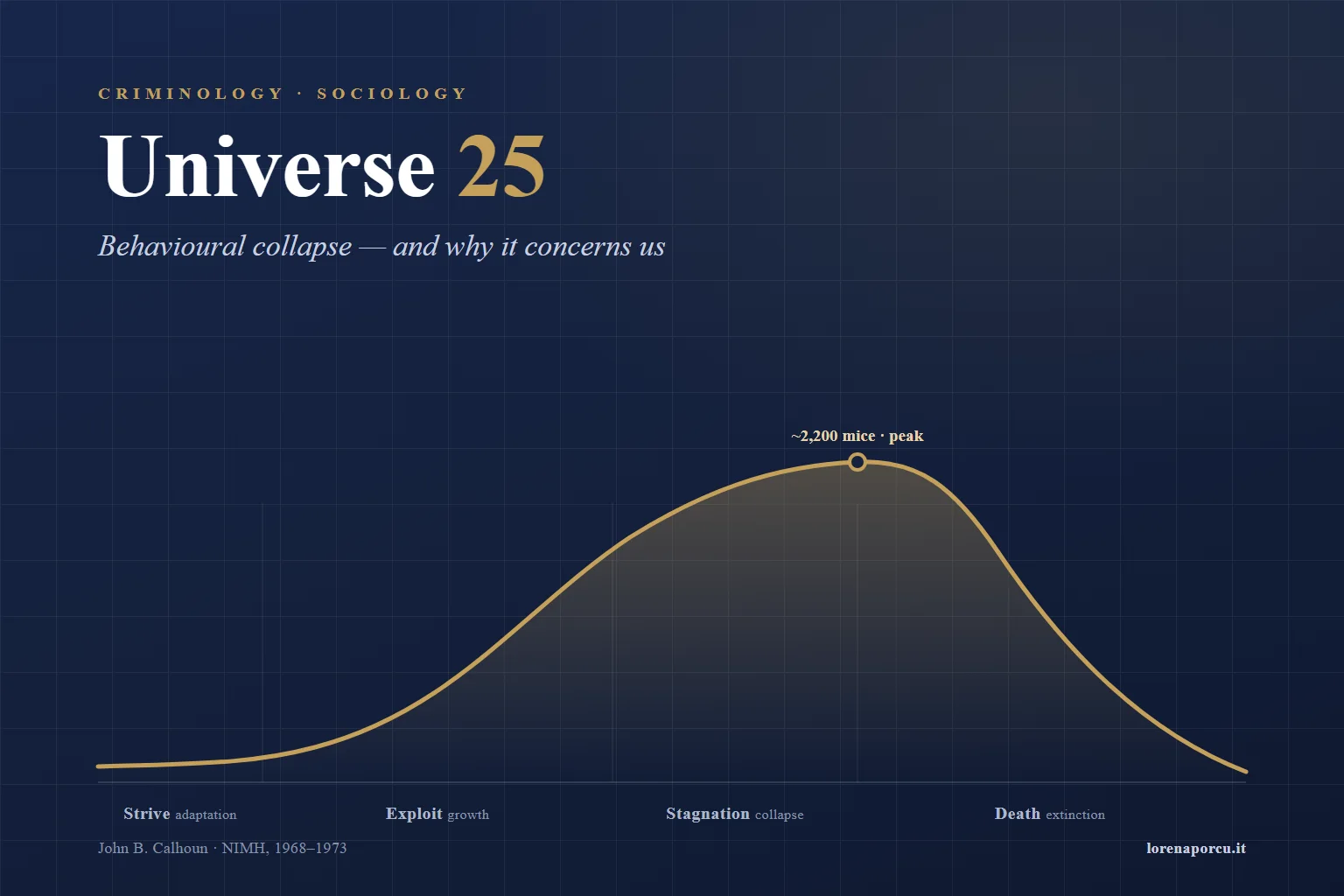
In his paper, Calhoun divides the duration of the experiment into four distinct phases, which chart mathematically the trajectory towards social death.
- Phase 1 — Adaptation (Strive), days 0-104. The first matings and territorial marking are observed. All well, as expected.
- Phase 2 — Exploitation (Exploit), days 105-599. Exponential growth is observed: the population doubles every 55 days. All normal, all expected.
- Phase 3 — Stagnation (Stagnation), days 560-919. Growth reaches a peak of around 2,200 individuals, then stops abruptly. Behavioural collapse (behavioral sink) sets in: care of the young disappears, and individuals emerge who display apathy, exclusive self-care and self-isolation. Calhoun calls them “the beautiful ones” (the beautiful ones) for the beauty of their coats and their particularly well-kept, blemish-free physical condition. Infanticide increases, rising to as much as 90%, as does aggression.
- Phase 4 — Death (Death), days 920-1588+. The last conception is recorded, and births fall to zero. The population undergoes an unstoppable negative growth until total extinction.
Calhoun closes the study with a formula he calls “Death Squared” (De × Ds), explaining that in hyper-congested social systems the first death is always that of the “spirit” and of relationships (Ds), followed inevitably and mathematically by the biological death of the body (De).
Let us try to shift the magnifying glass from the micro — the behaviour of the individual and the family — to the macro: the weight of space, of the environment and of social density in relation to deviance.
When the environment generates deviance
Within the criminal sciences there is an entire strand of research that studies how architecture, urban planning and overcrowding shape human behaviour. This theoretical premise built the founding assumption of Universe 25, whose outcomes went well beyond the scientist’s expectations: they offered evidence that reaches beyond the study of overpopulation, demonstrating the fundamental importance of the social roles that stabilise a society and keep it healthy and prosperous, and without which it is destined for a devastating drift.
For decades classical criminology sought the causes of crime almost exclusively within the individual (biological anomalies, psychological trauma) or in the economic structure (poverty, unemployment). Yet, from the early twentieth century onwards, the Chicago School and sociologists such as Robert Park, Ernest Burgess and Roderick McKenzie, in the essay The City, introduced a revolutionary truth: physical space is not a neutral container, but a social actor in its own right.
Environmental criminology shows that the geometric layout of our cities, the architecture of neighbourhoods and, above all, the concentration of individuals in confined spaces filter and alter human interactions. There is a biological and relational threshold beyond which forced coexistence ceases to produce sociability and begins to generate pathology. When a community exceeds a certain threshold of residential and social density, the mechanisms of spontaneous behavioural regulation seize up: the social order fragments, giving way to dysfunctional adaptive responses, radical isolation or hypertrophied aggression.
The paradox of abundance and a new anomie
Traditional sociology has always linked deviance and violence to the concept of deprivation. Robert Merton’s strain theory, for instance, suggests that the criminal act arises from the gap between cultural goals (success, prosperity) and the legitimate means of achieving them. From this standpoint, violence is the offspring of scarcity.
But what happens if we overturn this paradigm entirely? What becomes of a society in which the struggle for material survival no longer exists, where resources (food, care, consumer goods) are unlimited and guaranteed, but living space is progressively reduced?
In a context of total material abundance combined with extreme overcrowding, the individual experiences an unprecedented form of anomie. It is no longer the anomie of Émile Durkheim (the absence of norms caused by an economic crisis), but an anomie of relational overload: when every second of our existence is conditioned by the intrusive, inescapable and unchosen presence of the other, the social fabric does not strengthen — it wears thin and decomposes.
The human being, like many animal species, needs material and symbolic boundaries — territoriality — in order to structure their identity, their hierarchies and their routines of security. When territorial boundaries are wiped out by demographic density, by hyper-stimulation, by the absence of rules (or by rules that are not universally recognised), the capacity to establish social status and one’s own role breaks down. In an overcrowded society, traditional social roles — the parent, the leader, the very concept of a shared legal and moral norm — are emptied of meaning, because there is no physical and temporal space in which to exercise them, to reason through them and to validate them both to oneself and to others. The reference points that were once clear, expressed, comprehensible and, above all, shared fall away.
It is this phenomenon that introduces the sociological category of the Behavioral Sink (which may be rendered as “behavioural collapse” or “behavioural black pit”), of which Calhoun speaks and which he demonstrates in his experiment. Behavioural collapse is that point of no return at which the hyper-density of the population, coupled with the social anarchy that arose among the mice, attacks normal biological and social behaviours in favour of:
- hyper-reactive and apparently unmotivated aggression;
- the total collapse of the protective instinct towards the weaker members (females, the young, the elderly);
- the emergence of pathological drifts tied to pure aesthetic narcissism (the “beautiful ones”) or to destructive social apathy.
Universe 25 and contemporary society
Transposing Universe 25 to contemporary society is a fascinating and, in some respects, disquieting exercise. Calhoun himself designed the experiment with humankind in mind: the mice’s utopia was the metaphor for the emerging Western megalopolises of the 1970s.
Today, in the twenty-first century, that prophecy seems to have come true, but with an extension Calhoun could not have foreseen: overcrowding is no longer merely physical, it is also and above all digital. We live crammed together not only in metropolitan flats, but in “pocket cages” (smartphones) that connect us simultaneously to millions of people.
The “beautiful ones”, hyper-narcissism and the hikikomori
The most celebrated dynamic of Universe 25 is the appearance of the “beautiful” mice: males that had withdrawn entirely from social competition, from courtship and from the defence of territory. They spent their time solely eating, sleeping and grooming their coats. They were healthy, unscarred, but socially dead.
They represent the perfect breakdown of contemporary extreme individualism, which we see today in the culture of “looksmaxxing” (from looks and maxing, to maximise) and of pure appearance. The obsessive focus on aesthetics, on bodily care decontextualised from real relationships — living for the social media feeds — could be the modern equivalent of the mouse grooming its coat for hours on end: an atrophy of the capacity to handle relational conflict so as not to risk failure or rejection in the real world. The individual takes refuge in a sterile, comfortable shell of self-absorption.
We see it too, though for different reasons, in the phenomenon of the hikikomori: the voluntary social withdrawal of thousands of young people who choose self-isolation in their rooms, rejecting the outside world, mirrors exactly the retreat of the “beautiful ones”. Here, however, it is not a matter of narcissism, but of an underlying maladjustment that leads to an inability to live real relationships — relationships that require proximity and a management of the emotions with which these young people cannot cope. A maladjustment that springs from deep within, the causes of which will not be discussed here.
The black pit: gratuitous violence and polarisation
In the hyper-crowded enclosure of the mice, even amid endless food and every comfort, groups of hyper-aggressive individuals arose. They attacked their companions for no reason, practised infanticide and even cannibalism, despite the abundance of food. Violence had lost its biological function (defence, food, mating) and had become pure reaction to relational overload. The parallel with our own times needs no comment.
The disintegration of guiding functions
In the final phases of Universe 25, roles — and the very function of the role — collapse. The females stopped caring for their pups, abandoning them prematurely or attacking them; the males took no interest in procreation. Social roles broke down completely. The result was a total halt to births, which led to the extinction of the colony long before the mice died of old age.
The family of today appears disintegrated in its social role, and there is no longer even a shared frame of reference. The typical phrase “the family is where love is” — for all the beauty of the concept and the romantic implication, both laudable — adds nothing to the fundamental social role of which the family is the bearer and whose defining features it has lost.
Education today risks producing functionally illiterate people: individuals with qualifications, even at the highest levels, who in fact do not understand the world around them, lacking critical thinking and therefore easily manipulated by the media and by social networks. People with poor judgement, greater vulnerability to fake news and a tendency to accept information passively without verifying it.
As for demographics, industrialised societies have long recorded birth rates dramatically below the replacement threshold. Economic prosperity and technology, paradoxically, coincide with the refusal or the perceived impossibility of reproducing. The complexity of urban life, the cost of living and the psychological cost of relationships — the inability, to return to Calhoun’s “beautiful ones”, to relate properly and to manage difficult situations — discourage the formation of new family units. The fact that low-income families reproduce more than high-income ones tells us that those who would have the least economic difficulty in raising and educating children are the chief victims of this reproductive withdrawal, just like the “beautiful ones”.
As for the educational role, just as the mothers in the experiment gradually lost their protective instinct, today we witness a widespread fragility of the parental role. Parents, crushed by professional performance pressures and by an inability to manage their own children, often abdicate their role as guides, delegating emotional education to digital screens and creating those “relational fractures” that are often the cause of adolescent aggression — and, on closer inspection, of adult aggression too.
Modern social rage
Today, even before demographics, it is social networks that are the equivalent of the unsustainable density of Universe 25. We are “forced” to interact constantly with strangers, undergoing a cognitive overload: an excess of stimuli and information that our brain cannot process. Unable to flee physically, the biological response becomes aggression: hatred in the comments, cyberbullying and digital lynchings become the release valve of a humanity that feels “too close” and threatened by the other.
As for the widespread, unmotivated aggression of the experiment, one need only look at baby gangs and brawls during nightlife. Random assaults in the street, fights sparked by a lingering glance, muggings or petty theft have no economic motive (robberies born of hunger): they have, rather, a spatial and identity-based motive. People clash, they offend, in order to reassert a micro-territory in a world that has wiped out the boundaries of restraint, of common sense, of upbringing, of ethics, of civic sense and of respect for the law. The so-called baby gangs or “pack” (not to be confused with organised gangs belonging to specific criminal groups) are often the result of a proliferation of maladjusted individuals left to their own devices, without long-term goals and without a clear vision of themselves and of the direction to take.
Death squared
The real danger for our society is not the shortage of material resources, but the destruction of the relational fabric, brought about by an environment that is hyper-stimulating, hyper-connected and devoid of spaces for decompression.
Contemporary man, just like the mice of Universe 25, risks dying psychologically and socially long before his body ceases to function.